

If you’re looking for a high-energy team building activity that feels like a real battle but still works in a professional setting, the comparison almost always comes down to laser tag and paintball.
Both are popular shooting game formats and well-known team sport options — but in real corporate environments, the experience they create is very different.
Here’s what most organisers quickly discover once they look beyond surface-level excitement:
- Laser tag in Singapore is safer and more inclusive, making it suitable for mixed-age teams and even kids during family-oriented events.
- Paintball games have a loyal fan base, but participation will be uneven in corporate groups.
- Indoor laser tag removes weather risk and keeps a consistent playing field.
- Laser tag equipment eliminates physical impact commonly experienced in paintball.
- Most teams stay more engaged with the structured flow of a professionally run laser tag experience.
This guide breaks down paintball vs laser tag using real operational insights, so if you are deciding between the two for a corporate event, you can make the right call with confidence.
Additionally, if you want a complete guide on planning and structuring a laser tag team building event beyond just comparing activities, check out our laser tag team building guide.
Safety & Risk Comparison
Safety is often the deciding factor — especially when HR, management, or public-sector teams are involved.
In paintball, players fire pellets at speed. Even with protective gear, discomfort and minor injuries are common. Many first-time paintball players hesitate, which quickly creates an uneven experience where only a few dominate the game.
By contrast, laser tag is a non-contact format that uses infrared lasers and sensors. Modern laser tag guns register hits electronically, meaning no physical impact, no bruising, and far less fear going into the game.
From our experience running corporate sessions with Laser Tag Singapore, teams engage more confidently in laser tag because they can focus on teamwork and tactics rather than self-protection. That confidence directly translates into better communication and higher participation.

Inclusivity & Fitness Requirements
One of the biggest differences between laser tag and paintball is who actually enjoys to play.
Paintball — much like airsoft — appeals strongly to a specific fan base of the game. These players enjoy physical intensity and realism. But in a corporate setting, that intensity can exclude quieter participants, seniors, or anyone uncomfortable with pain or mess.
A laser tag game is designed to be accessible. Because movement, communication, and strategy matter more than strength, no one feels out of place. We regularly see:
- Mixed departments playing together
- Leaders and junior staff contributing equally
- Participants who normally opt out of physical games staying engaged
This makes laser tag a more reliable choice for inclusive team building activities.
Indoor vs Outdoor Flexibility
Weather can make or break an event — something organisers only appreciate after a last-minute rain forecast.
Most paintball fields are outdoors. Heat, rain, and uneven terrain affect pacing, morale, and fairness across teams. Muddy ground also changes the playing field, which can frustrate participants and complicate safety management.
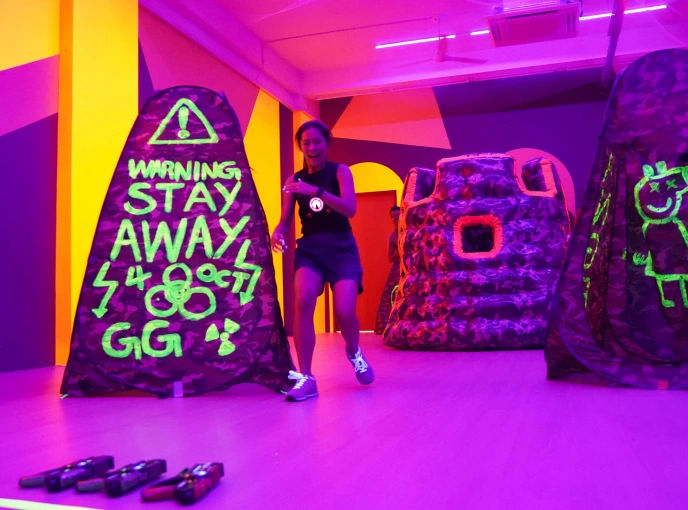
Laser tag, on the other hand, can be hosted indoors. Air-conditioned venues allow sessions to be run consistently, regardless of weather.
For organisers, this means predictable timing, smoother rotations, and a more controlled experience with the same rules applied throughout.
Cost, Logistics & Clean-Up
From an execution standpoint, paintball involves more variables than most planners expect.
Paintball games require pellet tracking, protective gear, longer safety briefings, and post-game clean-up. Transport to outdoor venues and downtime between rounds also add up — especially for the organiser managing the number of participants in a corporate group.
Laser tag setups are cleaner and faster. Laser tag equipment resets instantly, transitions are smooth, and sessions scale efficiently. That operational simplicity is one reason laser tag is frequently chosen for the corporate events where reliability matters.
Which Activity Fits Different Team Goals?
Instead of asking which is more exciting, the better question is what outcome you want from the game.
Laser tag is ideal if your goal is:
- Tactical combat scenarios without injury risk
- Clear scoring and a defined winner
- Communication-driven teamwork
- Structured laser tag missions such as capture, defend, or elimination

In laser tag, every player has a role. Teams plan, adapt, and react — and you can clearly see how collaboration affects results.
Paintball may suit you if:
- Your group already enjoys airsoft or paintball
- Physical intensity is the main objective
- You’re organising a small, homogeneous group
For most workplaces, laser tag offers a better balance of the game and teamwork.
Engagement Dynamics: What Actually Happens During the Game
On paper, both laser tag and paintball promise excitement. In reality, how teams behave during the game is where the biggest difference shows up.
In paintball, early eliminations are common. Once a player is hit, they’re often sidelined for long stretches. Over time, this creates a split dynamic: a few aggressive paintball players stay active, while others become spectators. For corporate teams, that drop-off matters — disengagement sets in quickly, especially among first-timers.
In contrast, laser tag games are designed to keep everyone involved. Most formats allow players to respawn, re-enter, or rotate roles. This ensures no one is excluded for long and energy stays consistent across the session. From a facilitation standpoint, this makes it much easier to maintain momentum and morale.
We’ve found that teams remain more vocal, more collaborative, and more invested in laser tag because every round feels like a fresh opportunity rather than a one-strike elimination.
You can read more about why laser tag team building works in our dedicated guide.
Learning Curve & Onboarding Time
Another overlooked factor when comparing paintball vs laser tag is how quickly participants can understand the game and start enjoying it.
Paintball requires:
- Detailed safety briefings
- Gear fitting and mask checks
- Comfort with being shot
This onboarding process takes time, and even then, some participants stay cautious throughout the session.
A laser tag game, on the other hand, is intuitive. Point, move, communicate, score. With modern laser tag guns and clearly explained objectives, most groups are ready to play within minutes. That shorter learning curve means:
- Less downtime
- Faster rotations
- Higher energy early in the event
For organisers running tight schedules or multiple rotations, this difference is significant.
Fairness & Competitive Balance
Corporate teams often include a mix of competitive and non-competitive personalities. The challenge is creating a fair playing field where results feel earned, not skewed.
In paintball, physical speed and aggression often dominate outcomes. Stronger or more experienced players naturally gain an advantage, which can discourage others from fully committing.
Laser tag shifts the focus. Strategy, communication, and positioning matter more than raw strength. Teams that plan routes, assign roles, or coordinate attacks consistently outperform teams that rush blindly — even if they’re less athletic.
This balance makes laser tag feel like a true team sport, where collaboration determines the winner, not individual dominance.
The Psychology of Participation
One subtle but important difference between laser tag and paintball is psychological safety.
Paintball introduces fear — of pain, of embarrassment, of being hit. For some, that adrenaline is exciting. For many corporate participants, it’s a barrier.
Laser tag removes that fear while preserving intensity. The absence of pain allows participants to take risks, experiment with tactics, and engage more freely. When people aren’t worried about getting hurt, they communicate more openly and move more confidently.
That psychological comfort is a big reason laser tag works so well for:
- Cross-department bonding
- First-time team building activities
- Mixed seniority groups
Suitability Beyond Corporate Teams
While this article focuses on corporate decision-making, it’s worth noting that laser tag’s flexibility extends further.
Laser tag can be adapted for:
- Company family days with kids
- School groups
- Mixed-age celebrations
Paintball, due to safety and age restrictions, is far more limited in this respect. If you’re planning an event where inclusivity matters beyond just employees, laser tag offers significantly more options.
Why This Comparison Matters
Choosing between paintball or laser tag isn’t just about excitement. It’s about:
- Who feels comfortable participating
- How long engagement lasts
- How smoothly the event runs
- What kind of memory teams leave with
For organisations looking for reliable outcomes — not just adrenaline — these differences are critical.
Final Recommendation for Corporate Teams
When comparing paintball or laser tag, the deciding factor is rarely adrenaline alone. It’s about inclusivity, safety, and how well the experience reflects your organisation’s values.
For most companies looking for a dependable, high-engagement option, laser tag consistently delivers better outcomes. Paintball will be thrilling for some, but laser tag works for almost everyone — from first-timers to seasoned competitors.
If you’re looking for an activity that creates energy without unnecessary risk, laser tag is usually the smarter corporate choice.
Key Consideration Factors for Organisers
- Scalability: Works for small teams and large groups
- Accessibility: Beginner-friendly, non-contact format
- Variety: Multiple missions and scoring formats
- Clarity: Clear rules and professional facilitation
- Safety: Controlled environment with modern equipment
Final Thoughts
Whether you’re choosing between laser tag and paintball, the best option is the one your whole team will enjoy — not just a few enthusiasts. For most organisations, a well-run laser tag experience strikes the right balance between excitement, inclusivity, and peace of mind.
If you’re planning a corporate team building event and want to explore whether laser tag is the right fit for your group size and objectives, feel free to reach out and speak with our team.
FAQs: Laser Tag vs Paintball for Team Building
What is the main difference between laser tag and paintball?
The main difference is impact. Laser tag uses infrared sensors, while paintball uses pellets. This makes laser tag safer and easier for mixed groups.
Is laser tag better than paintball for corporate teams?
For most companies, yes. Laser tag encourages participation across all fitness levels and avoids the hesitation often seen with a paintball setup.
Can kids play laser tag at corporate family events?
Yes. Laser tag is suitable for kids, teens, and adults when equipment sizing and rules are adjusted appropriately.
Is paintball more realistic than laser tag?
Paintball feels more physical, but laser tag delivers immersive combat scenarios without injury risk, making it more practical for corporate use.