
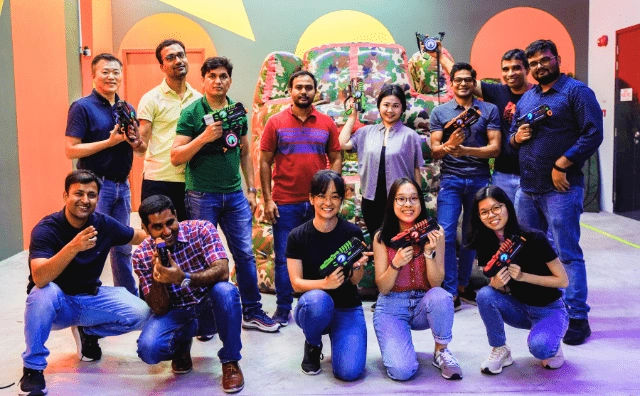
If you’re looking for a team building activity that’s energetic, structured, and genuinely engaging, laser tag in Singapore is often one of the first options people consider — and for good reason.
As an organiser, you’re probably asking the same questions many planners do.
Will this work for all ages and fitness levels?
Can it scale smoothly for any group size?
Will it actually help your team bond, or will it just feel like another game that people forget the next day?
These questions matter because team building today isn’t just about “doing something fun.” It’s about choosing an activity that justifies the time, budget, and effort — especially when you’re organising for your team, senior stakeholders, or a large organisation.
Here’s the bottom line upfront:
- Laser tag is a team-based experience, not just a physical activity.
- The best laser tag experiences focus on structure, flow, and facilitation — not chaos.
- Communication skills, teamwork, and strategy are naturally built into the game.
- It’s suitable for team building events, corporate offsites, and even crossover formats like birthday parties or mixed-age gatherings.
- When executed properly, it’s a fun and exciting laser tag activity that still works in a professional environment.
This guide explains what laser tag team building Singapore really involves, when it works best, how it compares to other activities, and how to choose a provider you can trust — especially if you’re organising for a corporate, government, or large group.
What Is Laser Tag Team Building?
At its core, laser tag is a structured group activity where teams compete using laser guns and sensor equipment in a controlled environment.
Participants wear sensors and use laser tag guns that emit infrared signals. Points are scored by tagging opponents, completing objectives, or controlling zones, depending on the game modes used.

In a corporate or organisational setting, however, the laser tag experience goes far beyond casual play.
A professionally run laser tag event focuses on:
- Clear objectives rather than free-for-all gameplay
- Defined laser tag games that reward teamwork
- Fair rotations to manage energy and engagement
- Safety-first facilitation and clear instructions
Instead of letting participants freely run around to play laser tag, team building laser tag Singapore programmes are intentionally designed to encourage planning, coordination, and decision-making.
In our experience running Singapore laser tag sessions for companies, this structure is what transforms the game of laser tag from a simple recreational activity into a meaningful team-building tool rather than just a fun distraction.
Why Laser Tag Works So Well for Team Building
Whether you’re planning for an office offsite or a large-scale engagement day, laser tag works because it forces people to collaborate as a team in real time.
Unlike many activities where a few outspoken or athletic participants dominate, laser tag distributes responsibility across the group. Players must communicate, reposition, support one another, and adapt quickly in the middle of the game.
We’ve found that teams engage best when:
- Objectives are simple and time-bound
- Roles emerge naturally instead of being assigned
- Players depend on their team mates rather than individual performance
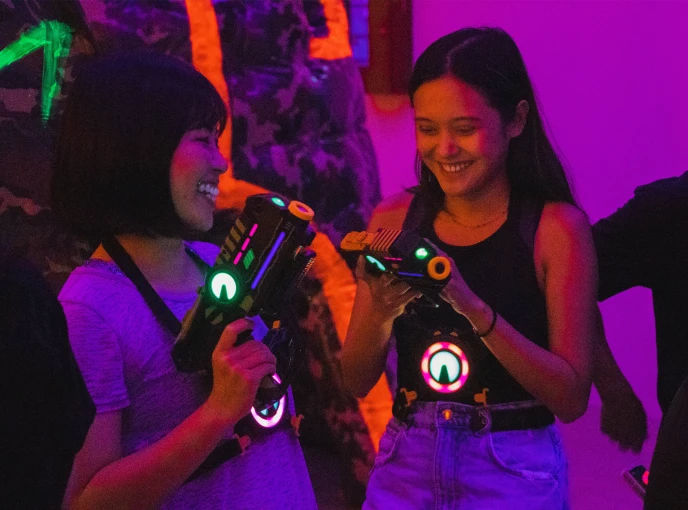
This is why laser tag games consistently outperform passive icebreakers or overly scripted workshops. People are engaged because their actions affect each other immediately.
If you want a deeper breakdown of the behavioural and psychological benefits, you can explore why laser tag team building works.
Why Laser Tag Succeeds Where Other Team Building Activities Fall Short
Many team building activities sound good on paper but struggle in execution. Icebreakers can feel forced, sports days may exclude less active participants, and puzzle-based workshops often engage only a small portion of the group.
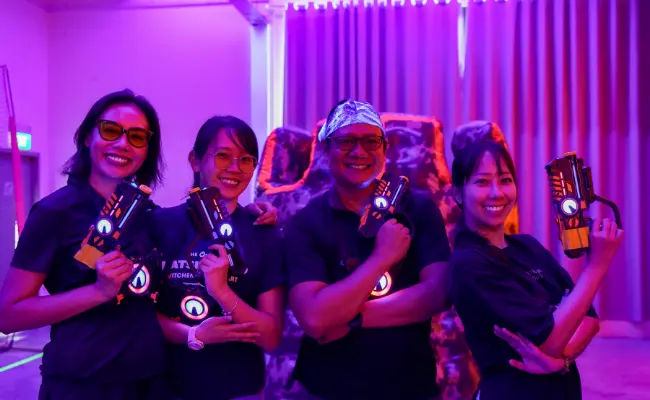
Laser tag works differently because it balances energy, structure, and inclusivity in a way few activities manage to achieve.
Unlike traditional sports, laser tag does not rely on speed, strength, or prior experience. Participants contribute through awareness, communication, and decision-making. This levels the playing field and reduces the pressure that often comes with physical activities. Even first-time players are able to participate confidently within minutes.
At the same time, laser tag avoids the awkwardness that can come with discussion-heavy or icebreaker-style activities. There’s a clear objective, a defined role for each participant, and immediate feedback through gameplay. Teams do not need to be “creative” or outspoken to participate — they simply need to engage.
From an organiser’s perspective, this makes laser tag especially reliable. Engagement happens naturally, without facilitators needing to push participation or force interaction. Teams focus on the game, and bonding happens as a by-product rather than a requirement.
We’ve also found that laser tag performs well across mixed groups — including different age ranges, departments, and seniority levels. Because the activity is immersive and time-bound, participants stay present. Phones stay away. Attention stays on teammates and objectives.
This combination of low entry barrier, high engagement, and clear structure is why laser tag continues to outperform many conventional team building formats, particularly for groups that want something fun without sacrificing professionalism.
For organisations that want a balance between excitement and control — rather than extremes at either end — laser tag sits in a practical middle ground.
Common Team Building Objectives Laser Tag Solves
Improving Communication and Coordination
Every laser tag game demands fast decision-making. Teams must share information clearly, coordinate movements, and adjust strategy mid-round.
In real sessions, we often observe:
- Teams creating their own call-out systems
- Participants learning to give concise instructions
- Groups improving coordination after just one round
These moments directly challenge and strengthen communication skills in a way classroom-style activities or discussion-based workshops rarely do.
Building Trust and Team Cohesion
Because success depends on the group:
- Teams learn to move together
- Players cover each other
- Mistakes become shared learning moments rather than individual failures
Wins and losses are collective. This makes our laser tag sessions especially effective for teams that don’t usually work closely together, such as cross-department groups or newly formed teams.
Developing Leadership and Strategic Thinking
Across many laser tag experiences, leadership tends to surface organically. Without assigning roles, teams naturally identify planners, coordinators, and on-the-ground decision-makers as the game unfolds.
This makes laser tag useful not just for bonding, but also for observing how teams operate under pressure.
Common Mistakes Organisers Make with Laser Tag Team Building
While laser tag is easy for participants to pick up, execution quality varies widely
Based on real event experience, here are some of the most common mistakes organisers run into, and why they matter.
Treating Laser Tag Like Casual Play
One of the biggest mistakes is assuming laser tag “just works” without structure.
Without clear objectives and facilitation, sessions quickly turn chaotic. Louder or more aggressive participants dominate, while others disengage. What should be a team experience becomes fragmented and uneven.
Professional team building formats are designed differently — with rules, pacing, and roles that encourage participation from everyone.
Overcrowding Sessions to Save Time or Cost
Trying to squeeze too many participants into a single session often backfires.
Overcrowding leads to:
- Confusing gameplay
- Safety concerns
- Reduced engagement
- Frustration from participants who feel lost
It’s usually better to run more structured rotations with fewer people per round than to rush everyone through at once.
Underestimating Briefings and Instructions
Clear briefings are not optional.
When instructions are rushed or unclear, participants spend the first half of the session confused rather than engaged. This affects energy, confidence, and overall enjoyment.
In well-run sessions, briefings are concise but deliberate, ensuring everyone understands:
- Objectives
- Scoring mechanics
- Safety boundaries
- Team expectations
Choosing Based on Price Alone
Laser tag pricing can vary widely. What’s often overlooked is what’s included beyond equipment.
Lower-cost setups may lack:
- Trained facilitators
- Proper rotation planning
- On-site problem solving
The difference between an average and a great experience often comes down to facilitation and execution, not hardware.
Is Laser Tag Suitable for Corporate and Government Teams?
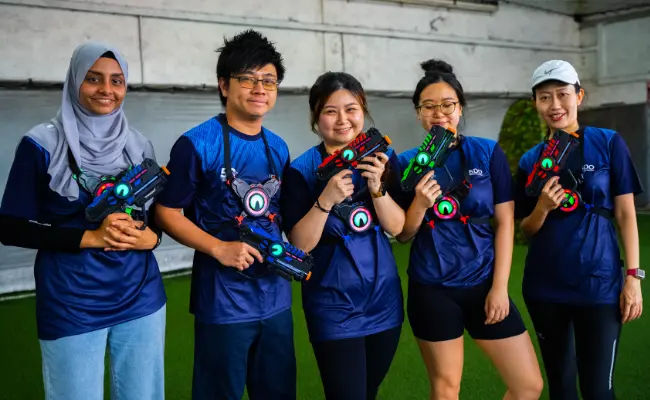
This is one of the most common — and most important — questions organisers ask. Laser tag itself isn’t the deciding factor. Execution, structure, and facilitation are what determine whether it works in a professional environment.
Below is how laser tag performs across different organisational contexts, based on real-world execution rather than theory.
For Corporate Teams
For corporate teams, laser tag works best when the goal is engagement, cohesion, and communication, rather than deep analytical problem-solving.
In our experience, laser tag is particularly effective for:
- Teams that spend most of their time in meetings or behind screens
- Departments that don’t regularly interact with one another
- Organisations looking to energise teams without making anyone feel uncomfortable
Unlike sports-based activities, laser tag doesn’t reward speed or strength alone. Participants contribute through communication, positioning, and awareness, which makes it easier for quieter team members to participate meaningfully.
It’s also why laser tag works well for mixed seniority groups. During the game, hierarchy fades quickly. People focus on objectives, teammates, and situational awareness — not job titles.
That said, laser tag may be less suitable if your objective is:
- Long-form discussion or reflection
- Deep skills training
- Quiet, workshop-style learning
In those cases, it’s better positioned as a high-energy bonding segment, not the entire programme.
For Government and Statutory Board Teams
Government and statutory board teams often have additional considerations around safety, inclusivity, and optics.
Laser tag works well in these settings because it is:
- Non-contact and low risk
- Rule-based and easy to control
- Suitable for a wide range of fitness levels
Indoor or fully sheltered venues are typically preferred to ensure predictability and minimise external variables like weather. Clear briefings, structured rotations, and facilitator-led gameplay are essential to maintain professionalism.
From an organiser’s perspective, the biggest advantage is control. Well-run laser tag sessions are easy to pace, easy to explain, and easy to justify internally because expectations are clear from start to finish.
For Large Groups (40–300+ Pax)
Large-group execution is where experience matters most.

Laser tag can scale very effectively, but only when:
- Rotations are carefully planned
- Waiting time is managed intentionally
- Facilitator-to-participant ratios are sufficient
Poorly planned sessions often suffer from long idle periods, disengaged participants, or unclear transitions between rounds.
In professionally run sessions, groups are split into manageable sub-teams, gameplay is rotated smoothly, and energy levels are maintained across the entire programme.
For uniformed groups or unit-based bonding, you may also want to explore NS Cohesion Activities, where similar principles apply at even larger scales.
When Laser Tag May NOT Be the Right Choice
Being transparent matters.
Laser tag may not be ideal if:
- Your group strongly prefers quiet, discussion-based activities
- Physical movement is highly restricted for most participants
- You’re aiming for deep problem-solving rather than engagement
In these cases, alternatives like workshops or virtual team building games may be more suitable.
Laser Tag vs Other Team Building Activities
Compared to puzzle-based activities or physically demanding sports, combat skirmish laser tag offers higher inclusivity and easier group control.
Some organisers also explore concepts like combat skirmish or laser quest Singapore–style formats. The key difference lies in facilitation and structure.
If you’re weighing different combat-style team activities, our comparison of laser tag vs paintball for team building breaks down safety, inclusivity, and group suitability.
Indoor vs Outdoor Laser Tag for Team Building
Indoor Laser Tag
Indoor formats are often preferred for corporate groups because of:
- Air-conditioning
- Controlled lighting, including neon laser tag setups
- Predictable pacing and acoustics
These setups work well for professional environments and mixed-age groups.
Outdoor or Sheltered Laser Tag
Outdoor or sheltered formats are better suited for:
- Large-scale engagement days
- Carnival-style programmes
- Groups looking for a more open, energetic environment
Both options can support a variety of objectives when designed properly.
How to Choose the Right Laser Tag Team Building Provider
Choosing a provider isn’t just about finding someone who offers laser tag. It’s about choosing a team that understands group dynamics, pacing, and outcomes.
Here’s what experienced organisers should look out for.
Specialisation Over General Event Providers
Providers who specialise in laser tag experiences tend to deliver smoother sessions than general event companies offering laser tag as an add-on.
Specialists understand:
- How different game modes affect engagement
- How to manage flow for small vs large groups
- How to adjust pacing in real time
This experience shows most clearly during live execution, not in proposals.
Facilitation and Manpower Planning
Good facilitators don’t just start games — they manage the experience.
They:
- Keep teams moving
- Step in when rules are unclear
- Maintain safety and fairness
- Adjust energy levels as needed
Ask how many facilitators will be on-site and what their roles are. This often matters more than venue size or equipment count.
Equipment Reliability and Game Design
State-of-the-art equipment is important, but reliability matters more than novelty.
Well-tested laser tag games with proven mechanics tend to deliver better outcomes than overly complex formats that confuse participants.
Simple objectives executed well almost always outperform complicated setups.
Transparency and Expectations
A reliable provider sets clear expectations:
- Who the activity is suitable for
- How long sessions realistically take
- What happens if adjustments are needed
Transparency builds trust and reduces organiser stress on event day.
What a Corporate Laser Tag Session Looks Like
A well-run laser tag experience typically includes:
- A clear briefing covering rules, safety, and objectives
- Multiple rounds using different game modes
- Active facilitation throughout the session
- Smooth rotations to manage energy and waiting time
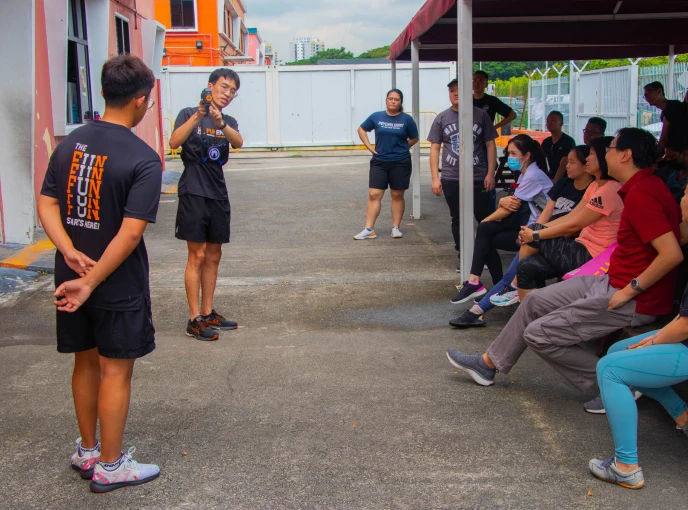
This approach keeps the experience fun and organised, even for large groups.
What Happens During a Poorly Run Laser Tag Session (and How to Avoid It)
Understanding failure points helps organisers make better decisions.
In poorly run sessions, common issues include:
- Long waiting times between rounds
- Confused participants unsure of objectives
- Safety rules being ignored or misunderstood
- Energy dropping sharply after the first round
These problems usually stem from poor planning, insufficient facilitation, or unrealistic group sizing.
Well-run sessions avoid this by:
- Planning rotations in advance
- Briefing clearly and consistently
- Assigning facilitators to manage flow
- Adjusting gameplay in real time
From an organiser’s perspective, this difference is what separates a stressful event day from a smooth one.
Key Consideration Factors for Organisers
- Scalability: Suitable for small teams and large organisations
- Accessibility: Inclusive and suitable for all ages
- Variety: Multiple laser tag games and formats
- Clarity: Clear instructions and expectations
- Flexibility: Ability to design laser tag with different objectives
Final Thoughts: Is Laser Tag Right for Your Team?
If you’re looking for a team building activity that’s structured, inclusive, and genuinely engaging, a laser tag event remains one of the most reliable options for your organisation.
Whether it’s a competitive game of laser tag, a strategic format layered with objectives, or simply a fun way to bring people together, success comes down to professional execution.
If you’d like to explore what a well-run laser tag session could look like for your team or clarify what works best for an upcoming programme, feel free to get in touch with us. We’re happy to walk you through the options clearly, realistically, and without pressure.
FAQs About Laser Tag Team Building
Is laser tag in Singapore suitable for corporate team building?
Yes. Singapore laser tag formats are widely used for corporate and government groups because they are safe, inclusive, and professionally structured.
What makes the best laser tag experience for teams?
The best laser tag focuses on facilitation, pacing, and clear objectives rather than just equipment or visuals.
Can we use laser tag for team building events and birthday parties?
Yes. Laser tag can be adapted for team building events, social gatherings, and birthday parties, depending on the format and facilitation style.
Are laser tag guns safe to use?
Yes. Laser tag guns use infrared technology and are non-contact, making them suitable for your team.
How long should a game of laser tag last?
Most corporate sessions run between 1.5 and 3 hours, depending on the group size and goals.